
Electronics
Programming with Arduino
Code and control lights, sensors and motors through practical electronics projects.
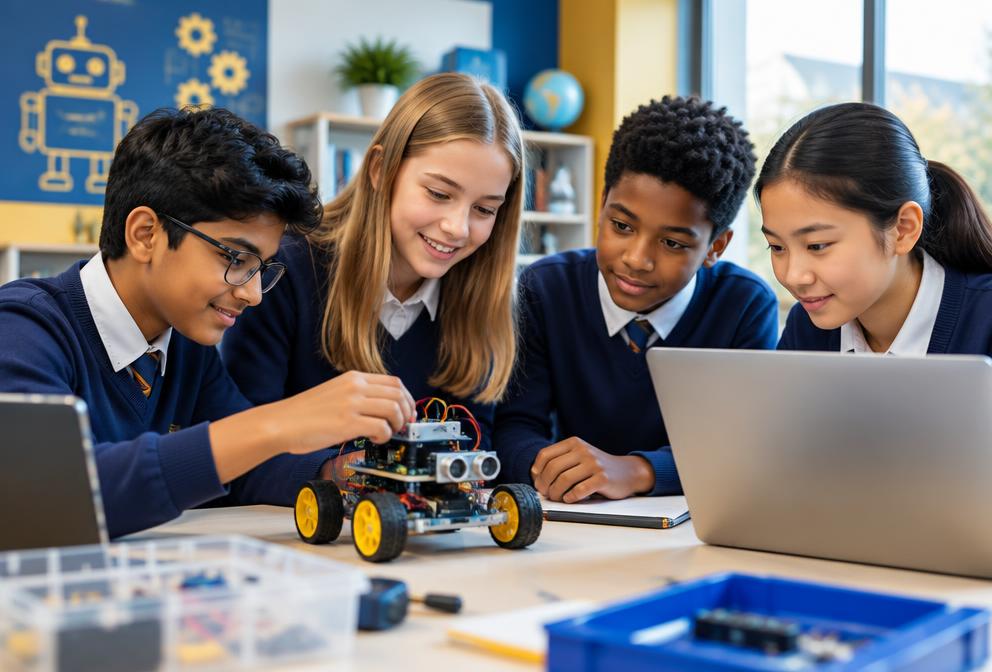
What students learn
- Arduino basics
- Circuits
- Sensors
- Motors
- Interactive builds
Learning outcomes
- Connect code with hardware
- Understand simple electronics
- Build working prototypes
Course overview
Programming with Arduino for Kids (Ages 10–16)
Build, Code, and Invent Your Own Electronic Projects
This programme teaches children how to use the Arduino microcontroller to build interactive electronic projects.
Students learn Arduino basics, block and text coding, circuits and electronics, sensors and actuators, real-world problem-solving, innovation and invention.
Learners progress from simple LED blinking to building full mini-projects that use sensors, motors and displays.
Age group
10–16 years
Total duration
40–50 hours
Format
10 modules (4–5 hours each)
By the end of the course, learners will be able to
- 1Understand what an Arduino is and how it works
- 2Build simple circuits using breadboards, LEDs, sensors and wires
- 3Code using Arduino IDE (block coding or text-based C++)
- 4Control LEDs, buttons, buzzers, motors and sensors
- 5Read real-time sensor data and act on it using code
- 6Solve real-world problems using hardware and software
- 7Debug, test and improve electronic projects
- 8Create a final invention using Arduino
Tools & platforms
Programming
Hardware & components
10 modules
Course modules
- Module 1Introduction to Arduino & Basic Electronics
- Module 2Breadboard Basics & Simple Circuits
- Module 3Arduino Coding Essentials (Block Coding & Text Coding)
- Module 4Sensors – Reading Input from the World
- Module 5Sound, Buzzers & Piezo Music
- Module 6Motors & Physical Movement
- Module 7LCD Display & Output Devices
- Module 8Combining Sensors, Logic & Code (Intermediate Projects)
- Module 9Debugging, Testing & Project Improvement
- Module 10Final Arduino Innovation Project & Showcase
Certificates & Awards
- Young Inventor Award
- Best Circuit Builder
- Best Coding Logic
- Most Creative Project
- Future Engineer Award
What comes next
Progression pathways
- Raspberry Pi Programming
- Robotics & Automation
- IoT Projects for Kids
- Python Programming Fundamentals
- STEM Engineering Design Challenges
How tuition works
Students can learn in supportive small groups or through individual tuition. Lessons follow clear objectives, guided practice and regular feedback. Academic courses cover the relevant National Curriculum and OCR, Edexcel, AQA or Cambridge requirements where applicable.