
Programming
Coding in Python
A beginner-friendly route into one of the world’s leading programming languages.
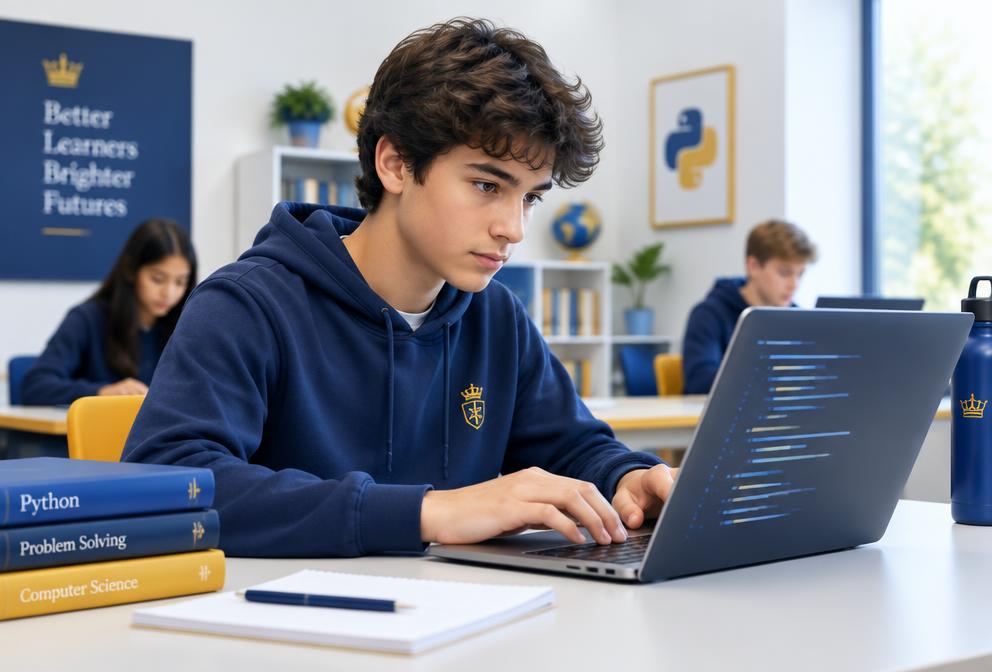
What students learn
- Variables and data
- Conditions and loops
- Functions
- Problem-solving
- Automation and projects
Learning outcomes
- Write and understand Python
- Solve problems logically
- Build a foundation for STEM study
Course overview
Coding in Python for Kids – Learn to Code, Create and Problem Solve
Python — one of the world’s most popular programming languages — is introduced in a simple and engaging way.
Students write code, make decisions with logic, use loops, draw graphics, build games and create mini-apps, finishing with the confidence to build their own projects.
Age group
Ages 10–16 (beginners to early intermediates)
Total duration
45–60 hours
Format
10 modules (4–6 hours each) · recommended over 10–12 weeks
By the end of the course, learners will be able to
- 1Understand core concepts — variables, loops and conditionals
- 2Write and run Python programs in Trinket, Replit or Thonny
- 3Use functions and lists to organise data
- 4Create text-based and simple graphical games
- 5Apply debugging skills and logical reasoning
- 6Develop and present a final mini project
Tools & platforms
Platforms
Libraries
Optional
10 modules
Course modules
- Module 1Introduction to Python and Coding Concepts
- Module 2Variables, Data Types and Operators
- Module 3Making Decisions with Conditional Statements
- Module 4Loops and Repetition
- Module 5Working with Strings and Lists
- Module 6Functions and Reusable Code
- Module 7Working with Graphics (Turtle Library)
- Module 8Files, Randomness and Simple Games
- Module 9Debugging, Testing and Problem Solving
- Module 10Final Project – Create and Present Your Own Python Program
Certificate of Completion
Awarded for completing all modules and presenting the final project.
What comes next
Progression pathways
- Python Game Development (Pygame)
- AI and Data Science for Beginners
- Web Development with Python (Flask / Django basics)
- App Development with Python (Kivy)
How tuition works
Students can learn in supportive small groups or through individual tuition. Lessons follow clear objectives, guided practice and regular feedback. Academic courses cover the relevant National Curriculum and OCR, Edexcel, AQA or Cambridge requirements where applicable.